Saturday, 30 April 2011

Works in Progress

Lately, I've found that several of the gardens I've visited have something vital in common: the National Garden Scheme. All are quite private places which open to the public a few times a year. Preparations for these openings give a new rhythm to the gardening year.

A few photos of two of these gardens, both in Brighton, which will open in the Garden Gadabout and National Garden Scheme this summer: first, 1 Belton Close, part of the Round Hill Gardens, taken mid-March.


There was a sense of readiness in the garden, especially with the carefully wrapped-up banana tree and propagation modules in the greenhouse. Everywhere, new shoots were just appearing, after the long winter.

Next, the Garden House, just before and after the Mediterranean heatwave. First, a few tulips, early April:

Although some had already gone over, still an arresting combination of colours.

Below, species tulips, delicate and subtle colours.


Then, after the tropical weather:


Seeing gardens fast-forward into summer can be disorientating, though a sign of the times. With the unusual weather, gardeners have to be more flexible and inventive - and to work harder to realise their plans. Then, come what may, there will always be something to see.


The Garden Gadabout: Sundays 26 June and 3 July 12pm - 5pm

National Garden Scheme: the Garden House, Fri 17 June, 6 - 8.30pm
1 Belton Close: Sunday 31st July 2011, 11am-5pm (for details, see www.ngs.org.uk)

Monday, 28 March 2011

A Day at the London Orchid Show


Pressed for time, just wanted to put up a few pictures of the London Orchid Show, held at the RHS Horticultural Halls in Westminster last weekend
. I was fortunate to be let in early, thanks to an exhibitor; had a quiet wander around and so could take in the diversity of flowers, which always amazes.

By the afternoon, the place was buzzing (anticipation building up to the 3.30pm sell-off, when there was a chance to buy plants from the exhibits), and the scent from so many orchids in one place was almost overpowering.

A diamond mine design to celebrate the diamond anniversary of the Orchid Society of Great Britain, awarded Most Innovative Display.

McBean's Orchids - an island of cymbidiums and odontoglossums crowned by a palm tree, gold medal winners.


A terrarium, so you can grow plants from all over the world, in an educational display by Helen and David Millner, awarded a gold medal.
Pleiones (bugle-like flowers at the front), by Maren Talbot of Heritage Orchids - there was also a sublime yellow and white one, Pleione Krakatoa (Wheatear), but it wasn't for sale, unfortunately. Still, I came away with a lovely miniature version, though this Himalayan plant needs cool, and so as to stand a chance on my balcony, I'm hoping to put together some sort of wind shield or mini beach hut, maybe.

Looking forward now to going to the spring show at the Glasshouse, Wisley, at the end of next month.

Monday, 21 February 2011

Wisley Wonders

Each month, Wisley is holding a plant specialist weekend - coming up are hellebores next month and auriculas at the end of April. A couple of weekends ago, I was there for a talk by Jim Durrant of McBean's Orchids and a tour of the orchid collection. I really enjoyed both.

If a pattern - or apparent obsession - seems to be emerging in these postings, just to mention that recently I've been researching orchids for a chapter on plants in a book-in-progress. Also, the Orchid Society of Great Britain is celebrating its diamond jubilee this year, and I've been following preparations for forthcoming shows (more on these in a future posting).

Just a few photos of the orchid house at Wisley for now:


Afterwards, there were the tropical butterflies in the glasshouse. An apt follow-up since orchids and butterflies seem to me to have a few things in common as specialist interests. Orchids are similarly delicate, mysterious creatures, though have obvious advantages as a hobby, not least on account of the element of cruelty in butterfly-collecting. This train of thought originates for me with Vladimir Nabokov's fascination with butterflies.
(A quick digression: while he was research fellow in entomology at Harvard, Nabokov and his wife spent their summers butterfly-hunting in North America and Europe. As a respected lepidopterist who wrote academic papers, he presents an unusual case of a writer who was also an expert in another, seemingly unrelated field. In an interview in 1971, however, Nabokov linked both expertises, saying that although he still continued to hunt butterflies, he no longer published academic papers since "the miniature hooks of a male butterfly are nothing in comparison to the eagle claws of literature which tear at me day and night".)

The most striking butterflies in the glasshouse were black with grey or blue markings. The first I saw seemed to have escaped from the exhibition area; I hadn't been prepared to see a creature about the size of my hand gliding in a slow zigzagging movement through the gallery, obviously a bit lost. When I reached the exhibition walkway, it was fascinating to see how they moved as if in slow motion. Like swallows in extremely leisurely flight. Occasionally, they fluttered out of harm's way.
I thought they were remarkably calm despite the visitor numbers - much calmer than most of the visitors. It was midday, and there were a few traffic jams on the stairs (best to go early, if you're going). There was a real excitement in the air: people stood still, gazing at butterflies and orchids, both strangely beautiful creatures. I heard later from a friend that one of the assistants had brought out a butterfly that had just hatched, holding it on a little stick.

Afterwards, I asked one of the RHS guides, Connor, also a tree expert, who was directing people traffic outside the glasshouse, what he would especially recommend seeing in the grounds. Armed with a couple of seasonal tips for a tour, I was about to set off when I came across a friend who had also been at the orchids event - she and her mother had just toured the glasshouse. We stopped for lunch, by which time the weather had picked up. The morning had started grey and rainy, not garden-visiting weather, though I'd reminded myself on the way up that I'd be inside most of the time, for the talk and tour - yet there we were in glorious sunshine, coats off.

We headed first for the lake bordered by willow and dogwood stems, silver-grey, red and golden: I'd wanted to see them because I'd recently seen photos of coloured tree barks in the winter garden of Anglesey Abbey (the Garden House in Brighton were organising a tour there). We had to search a bit to find his favourite planting. Following the path round, where we caught sight of swans, there they were: silver birch trees underplanted with winter aconites. For me, this cluster of golden flowers outshone everything else in the landscape. (I realise that the shot below can't do it justice, though - in any case, it's well worth seeing for yourself.)

Then we walked through a woodland area - the wild garden - towards the rock garden. You could almost be in real woods (just have to close your mind to the distant din of the A3). We had a relaxing time slowly ascending Battleston Hill, planted with gigantic snowdrops, some doubles, as well as a whole host of other bulbs, all of them out, and I forgot to look out for the plant of the month, Iris "Katherine Hodgkin". Maybe it was because I'd had my fill of irises already: there had been deep purple dwarf irises in the beds outside the Clore Centre; elsewhere, in the wild garden, there were statuesque mauve irises. It was also a little overwhelming to see so many brightly coloured flowers when, by comparison, Sussex gardens and parks were still barely struggling out of winter, with only snowdrops and a few crocii on show. A walk around Wisley was a kind of fast-forward into spring.

My friend spotted our iris, fortunately, since it had slipped my mind - surrounded by a small crowd. It was set amongst some rocks, beneath a bonsai'd larch tree near the top of the hill. The petals were a delightful grey-blue with delicate yellow and black markings. The flower seemed to emerge from the earth - its tiny stem hidden somewhere. We'd been admiring the flowers for a while when it dawned on us: Iris "Katherine Hodgkin", plant of the month.

Just out of curiosity, I looked for it in the plant shop. An assistant said she wasn't sure they had any left - checking the system, she saw there were two but that could mean they were sold-out. There were none to be seen in the racks outside, though I hadn't thought about buying in any case. (I've since heard that the plant centre has sold 500: sold out in just over a month. Although it's unlikely there will be any new stock in the near future, they will come in again in August, as a dry bulb.) Instead, I picked up two lovely winter aconites. Close-up, their glistening flowers were sunflower-bright as well as jewel-like - a powerful colour for such a tiny flower. Described as an "early flowering plant" (January), it was a good memento for a day spent in an early flowering garden.

Sunday, 23 January 2011

Spring Thoughts


A few sunny spells are enough to bring spring to mind. I've started looking forward to seeing a few places that will come into their own before long: Gatton Park for snowdrops, Eltham Palace for its moat planted with spring flowers (as recommended by John Watkins, Head of Gardens and Landscapes at English Heritage) and Ightham Mote for bluebells.

This January has been darker than usual: since our unusual weather last year, I've become more interested in weather forecasts, and so far this month quite a few reports have remarked on dark skies in the mornings. There seems to have been a lot more cloud this year. In the first week of the year, at 7 it still felt like the middle of the night. Nature writer Paul Evans recently summed it up: 'January looked glum'.

But the god of January, Janus, looks forward as well as back, and those sunny spells point the way forward. I first came across Janus, the two-headed gateway god, in a medieval book on agriculture: each chapter began with a beautiful woodcut of a month. What impressed me about the woodcuts for the winter months was that there seemed to be more of an acceptance of the dark times of the years, an appreciation of the seasons. Janus had a particular vitality - the worst was over and a new year promised new opportunities.

As the gateway god, Janus might seem like a wintry god yet he holds the key to the future. The god in the above Roman image now used on an Australian coin, strikes me as steely and determined, rather than glum. In his prime, you could say. It's no accident that he sports a luxuriant beard since the first month of the year is traditionally associated with age (as with January, the old knight in Chaucer's The Merchant's Tale, although, admittedly, the story mocks foolish old age). On a less serious note, these days, post-Christmas, there's less heed paid to clean-shaven looks (less maintenance seems required in general, which comes as something of a relief to many).

A fortnight ago, I went to Gatton Park, in Surrey, where I heard that a return visit would be worthwhile for the snowdrops. I was there for a meeting of the Orchid Society of Great Britain; Gatton Park last belonged to Sir Jeremiah Colman, of Colman's Mustard fame, who was one of the country's first orchid growers. He started to hybridise plants in 1900; by 1905, he had twelve glasshouses, where thousands were hybridised.

Sir Jeremiah was a kind of orchid ambassador; he spread the word about orchid growing by sending plants around the world to encourage people. One plant sent to Honolulu was used in a beauty queen's crown.

The grounds of Gatton Park were laid out by Capability Brown - they had that indefinably dreamy look of a classic Brown landscape. A midnight blue lake in a haze surrounded by trees, viewed from a plateau of perfect lawn sloping down to it.

Gatton Park is part-managed by the National Trust and looked after entirely by volunteers. Recent initiatives include restoring vistas by removing trees. Wildlife is encouraged in every way: I heard that there were twenty-five pairs of herons - a major feature of Gatton Park, the original heronry on the lake was known as "the grand water menagerie". Other attractions include a Japanese garden recreated as part of Channel 4's Hidden Gardens series and a rock garden, where you'll find the snowdrops.

There was a fabulous display of orchids grown by members of OSGB in one of the greenhouses. Orchid names can be as colourful as the plants themselves, like the irresistible Paph Red Glory x Voodoo Magic (left).
These hothouse flowers also come into their own in the springtime, with forthcoming annual shows: the London Orchid Show, in March, and the RHS Chelsea Flower Show, in May.


- Gatton Park is open to the public on the first Sunday of each month, 1pm - 5pm (www.gattonpark.com).

Tuesday, 21 December 2010

Memories of Woodstock


The antiquity of Woodstock is not measured by a thousand years and Blenheim is heir to all the memories of Woodstock - Winston Churchill

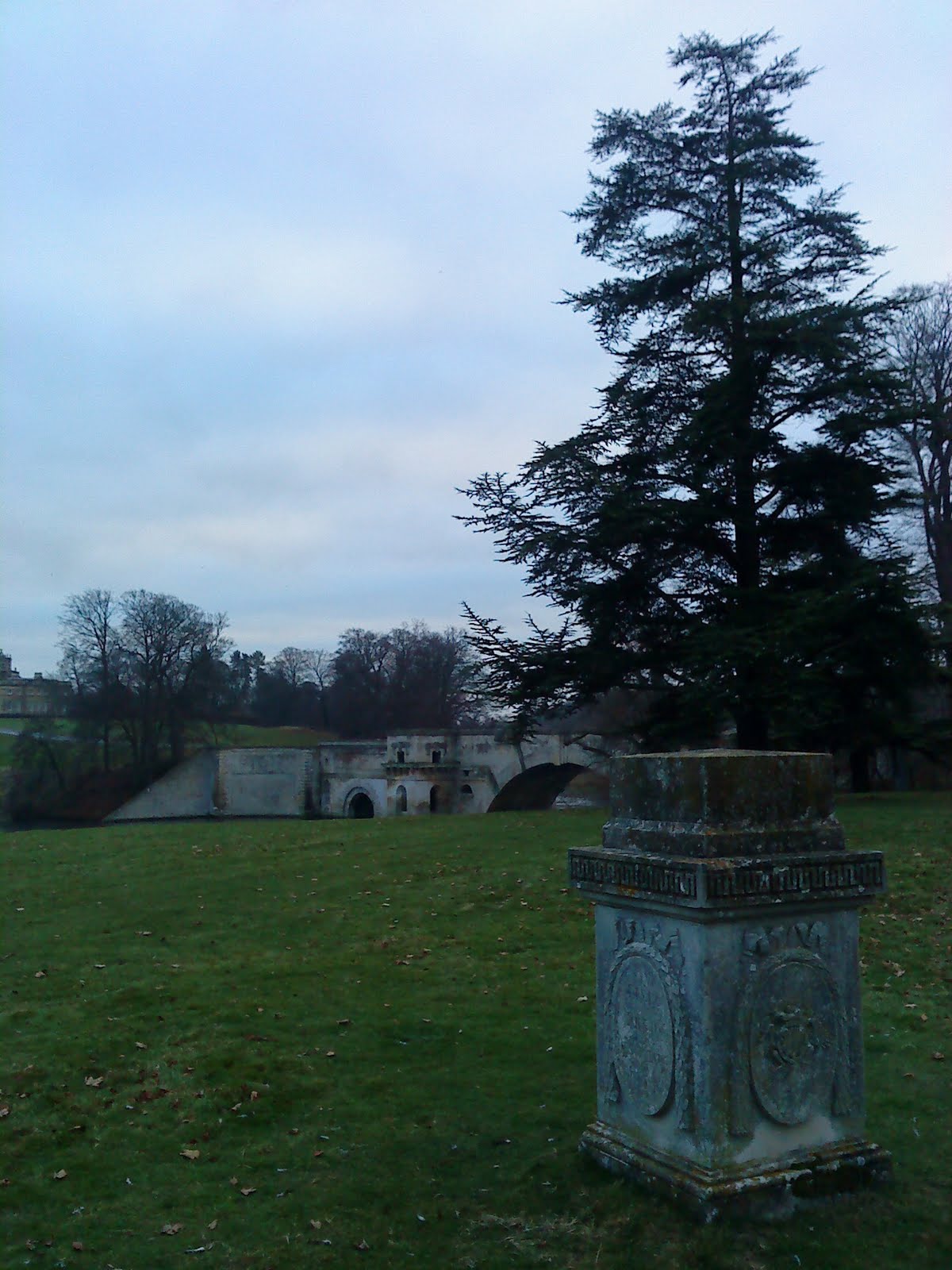
Last Sunday week, I went to Blenheim Palace to explore the grounds as part of some research about gardens as entertainment venues. I also wanted to search out the site of the medieval palace of Woodstock, where Elizabeth I was kept under house arrest as a princess. She had been granted liberty to walk in the gardens and often re-visited the palace as Queen, having appointed her Champion Knight Sir Henry Lee as keeper. The above dusky photo shows Sir John Vanbrugh's monumental bridge taken from across the River Glyme at the site of the ancient palace of Woodstock, with Blenheim in the background.

Spring or summer would obviously have been better choice for a visit, but last week was my last chance to see an exhibition on "Gulliver's Travels" (Blenheim is the location for a new 21st Century Fox film, starring Jack Black, Jason Segel and Billy Connolly: see www.gulliverstravelsmovie.co.uk for a fun trailer - opens Boxing Day). Sunday was the exhibition's closing day, and, as I discovered when I arrived, the final day that the house was open this year - it re-opens in mid-February.

I was lucky with the weather - that Sunday there was a thaw, with temperatures around 6', till lately what we'd have expected for December. The mild day made quite a contrast with the end of the week, when, along with much of the country, Brighton had been snowbound. There was even some lovely sunshine, and the low sunlight on the golden stone made the palace look more beautiful and strangely mirage-like.

About half an hour from Woodstock, I stopped at some services, reluctantly. Sitting there with a Starbucks, feeling both disorientated and coming to, thanks to the caffeine, there floated over the sound of a silver band - "Joy to the World", of all things. Only in Oxford . . . they even have classy services . . . The band was made up of amateur musicians who obviously played for the love of it (and had clearly been together a long time) - and, so I heard, donations helped keep them going.

By coincidence, another reason I'd wanted to make it that Sunday was that Blenheim was holding special festivities to end the season in style, with the City of Oxford silver band playing in the Great Hall and two choirs in the library (from Marlborough and Cranford House).

Approaching the palace, there were Christmas trees for sale outside, and in the grand courtyard it was fun to see trees between the columns. There was a huge crowd of visitors, but thanks to the enormity of the complex, there was just enough space, and people were in a good mood.

It was a little incongruous, in some ways, though, to see Christmas trees and cannons together. Maybe, a sign of progress, though?

The "Gulliver's Travels" exhibition alone was worth the trip. The high ceilings were hung with miniature red and white striped air balloons with tiny, cube-shaped wicker baskets. Holly wreaths crowned the busts like haloes, comically transforming their solemn appearance. There were Lilliputian homes (dolls' houses) and costumes from the film. My eye was also caught by something not part of the exhibition, a case of miniature lead soldiers from France, modelled on a selection of regiments who fought under Napoleon, which Churchill had wanted displayed in the palace.

The exhibition's star attraction was the sumptuous feast for a giant in the saloon: the enormous table was decorated with gold to replicate the banquet scene filmed in the Great Court. (Photographs weren't allowed but, hopefully, I'll be able to add some official ones soon.) There was a huge chair at the end of the table, an outsize plate and cutlery and a huge flute glass. In the film, so I heard from one of the helpful guides, the table stretched from the palace's front door to the centre of the courtyard, and Gulliver's chair was suitably massive (in the novel, an inhabitant of Lilliput measures the height of your hand; Gulliver was as tall as the tallest trees there).

The tricks of scale were fun, and I enjoyed listening to people's comments. On the huge wine glass - "I like the glass . . ." and "How many bottles would fit in that?" On Gulliver's chair: "That's a big chair"; a little girl beside me repeated "gigantic" in an awed voice, thoroughly enjoying the spectacle.

In the Red Drawing Room, I took in John Singer Sergent's portrait of John Churchill, 1st Duke of Marlborough clad in black armour and looking darkly handsome, as well as the chimneypiece adorned with Cupid and Psyche by Sir William Chambers. There was a magnificent view of the lawn, which in classic Capability Brown style seems both to sweep up to the house and roll to the horizon at the same time; and just above the window ledge you could see white roses.

A lady came to join me at the window and, turning to me, said, "Imagine having that as your view in the morning". An unfathomable thought. When visiting Blenheim, I wondered how many people imagine what it would be like to live there - for some reason, though, the idea of actually living in an historic house doesn't occur to me. I tend to be more drawn to speculate what it might have been like to have lived there originally - and also how the current family live there now. Or, if it's owned by the National Trust or English Heritage, how it's looked after and presented to people, as well as enjoyed.

It was interesting to come upon the bed of white roses on the way back from a wander round the grounds. And that what turned out to be my favourite planting of the day was something I'd first seen inside the house - white roses giving on to baroque gardens and a view of the lawn. The purity and delicacy of the frozen roses struck me as an unlikely but satisfying counterweight to the stately arched windows of the facade.

The last time I was at Blenheim (my second visit there) was to give a talk at the Independent Woodstock Literary Festival a couple of years ago. Afterwards, I walked to the ha ha at the edge of the great court, pictured left; it was a very warm summer's day, and the sheer scale of the place then deterred me from venturing into the grounds. But I knew I'd be back.

So it was satisfying this time to see the gardens properly - though obviously not at their best, they're architectural, with statuary, paths and topiary.
I was more interested in the woodland walks and the lake, in any case. Top of my list was Brown's newly restored cascade, which cleverly conceals the mighty dam. I was also determined to explore the site of Woodstock Palace and, if possible, to go in search of Rosamund's well, where Henry II rendezvoused with his mistress the Fair Rosamund. This was an elaborate banqueting house, with a water garden inside a garden: John Evelyn's delicate drawing memorably captures the chain of pools.

This posting has run on a bit, so I'll just show a few more pictures and try to cut down on the comments. (More details to follow in another shape or form, maybe.) First up, the cascade, which you hear before you see, since the path leading down the slope is curved. At a distance, the sound is gentle, a kind of rustling, then as I drew nearer, it became a torrential rushing of water, crisscrossing ravines. The pictures here can't do it justice, you have to experience it for yourself, but the sound effects are magnifed thanks to Brown's ingenious design, and disporportionate to the apparently modest scale of the cascade.
The dam holds back 570,000 cubic metres of water from the River Glyme, and the resulting 45-hectare lake is 7m deep in places. There was ice on the rocks; the water was clear, the foam snow-white and the yellow stone glowed. I was also impressed by the wildlife (plenty of happy ducks in the pool below the cascade).

There's a new path leading up to a viewing platform. Seeing the cascade from above is quite vertiginous (again, you have to see it for yourself), but it's the acoustics that really impress: the sound is ferocious. As the notes explain, the rocks were placed "so as to create as much movement and noise as possible". It's a kind of hydraulic conjuring act, you could say. There's a sense of the astonishing power of water - yet, after all the sound and fury, when I wandered up a woodland path on the other side of the dam, the lake above was as still as a mirror.

On the way back up to the palace, I walked through vivid red woods (copper beeches). Just to the left, the lake was eerily motionless. There was some novel planting in the shape of bamboos next to bull rushes. You feel miles away from everything yet soon enough the path rears up and you see the towers of Blenheim just above the trees.
A quick few last pictures to finish: a highlight from the point of view of looking at the garden as a venue of kinds, the Temple of Artemis (Diana, the huntress goddess), where Winston Churchill proposed to Clementine while they were sheltering during a downpour, 10th August 1908. They had just been for a stroll around the rose garden. This stately little Greek temple is certainly situated in a lovely spot. There's a dreamy view of Brown's magnificent lake, which moves from wide to narrow, resembling a river in the distance, one of the designer's trademark optical illusions.

I'd had such a good time, dusk was falling by the time I crossed Vanbrugh's bridge in search of the site of Woodstock palace. It was a wonderful vantage point for the bridge and palace; I also loved the little island planted with russet trees in the middle of the lake (which again, Brown the conjuror at work, resembles a river at this point). A couple of swans, luminous in the twilight, completed the romantic picture.
According to my map, Rosamund's well was somewhere by the water's edge and looked fairly off the beaten track (for its probable location see the clearing between trees, on the opposite side of the bridge to the site of the old palace, pictured below). Light was fading fast, and so it would have to wait.
On the way back to the car park, there was a happy atmosphere. Blenheim is so huge and there's so much to see that you're bound to end up tired out, in good way - which is how everyone seemed to me on the way homeward.
In the springtime, I'll return to see more of the gardens, especially the Secret Garden (restored in 2004), and for further exploration of the memories of Woodstock.